This Blog post #5 is entitled: Biodiversity – Evolution. It follows our last post #4: “Biodiversity – Genes” of this Biodiversity series.
This present post is inspired by chapter 3, “Evolution”, of Antonelli’s book, “The Hidden Universe: Adventures in Biodiversity”.
Biodiversity – Evolution
Antonelli’s Chapter 3 ‘Evolution’ begins with an account of last known sighting of the extinct Tasmanian tiger, or Tasmanian wolf. He discusses this animal because it quite dramatically highlights a tendency of evolution to produce new species in isolated habitats that have remarkably similar physical characteristics to mainstream species in the rest of the world. This is an example of ‘convergent evolution‘. It occurred despite the two species, the wolf and the thylacine evolving completely separately from different parent species in the different locations. The wolf is a placental mammal while the thylacine is a marsupial mammal.
Tasmanian Tiger
The Tasmanian tiger filled the same sort of habitat niche in Australia (including originally on the Australia mainland, Tasmania, and New Guinea) that wolves did in the land bridge connected continents of Europe and Asia.
Extinction and Loss of Evolution Biodiversity
Antonelli argues that extinction of animals such as the Tasmanian tiger resulted in the loss of not just one species but a disproportionate loss of evolutionary diversity representing millions of years of independent evolution.
Evolutionary Trees
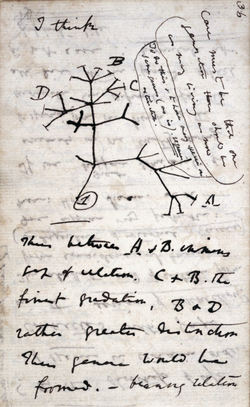
The concept of evolutionary trees began with Charles Darwin.
The following description extracted from the first paragraph of the Wikipedia phylogenetic tree reference (i.e. ‘evolutionary trees’), above, is reproduced below.
“A phylogenetic tree or phylogeny is a graphical representation which shows the evolutionary history between a set of species or taxa during a specific time.[1][2] In other words, it is a branching diagram or a tree showing the evolutionary relationships among various biological species or other entities based upon similarities and differences in their physical or genetic characteristics. In evolutionary biology, all life on Earth is theoretically part of a single phylogenetic tree, indicating common ancestry. Phylogenetics is the study of phylogenetic trees. The main challenge is to find a phylogenetic tree representing optimal evolutionary ancestry between a set of species or taxa. Computational phylogenetics (also phylogeny inference) focuses on the algorithms involved in finding optimal phylogenetic tree in the phylogenetic landscape.[1][2]“
Antonelli describes the phylogenetic tree and evolutionary diversity in simpler language than the Wikipedia article and the lay reader may find his presentation of these matters easier to digest.
Embracing Evolutionary Diversity
“So the time has come to embrace evolutionary diversity, …” Antonelli tells us. We must establish the relationship between species. He says that this is critical for prioritising species in the conservation effort and that it has numerous applications such as improving food security and our diets. He talks more about this in his Chapter 6.
Tree of Life
He then explains that during the past two decades he and his colleagues have been working “to sequence increasingly large amounts of DNA from thousands of species”. He further explains that there is still much more to be done to complete the “tree of life” which began 160 years ago and has a long way yet to go.
Ecological Roles of Branches of the Tree
In parallel to developing the tree, attention is being paid to understanding what ecological roles that particular branches and their species play.
He states that these roles are currently the least studied aspect of biodiversity but are perhaps one of the most important.
Biodiversity – Functions
The next Blog post, #6 of this series, will be entitled: “Biodiversity – Functions” and will be inspired by chapter 4, “Functions”, of Antonelli’s book, “The Hidden Universe: Adventures in Biodiversity”.
(Post updated: 14/04/2026.)