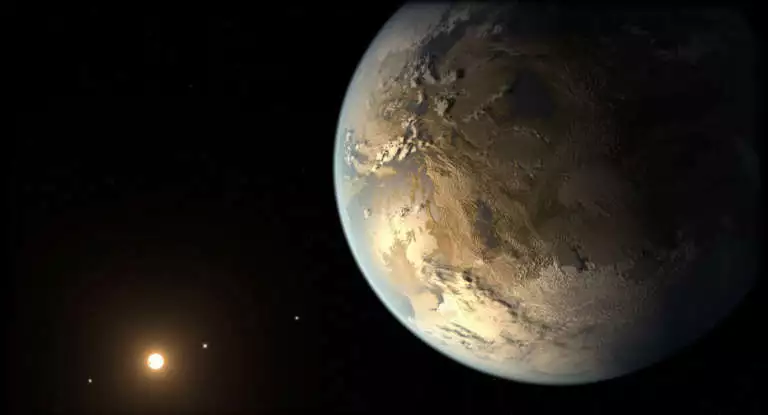
An exoplanet is any planet beyond our solar system. Most of them orbit other stars, but some free-floating exoplanets, called rogue planets, are untethered to any star.
NASA
NASA has an excellent web site devoted to Exoplanets and NASA’s research into these planets. It includes pages devoted to “the search for life“.
The Exoplanet topic has a bearing on the probability of life on other planets in our galaxy. The nature of recently discovered exoplanets suggests that the conditions for life are perhaps much rarer than previously thought. Nevertheless, even allowing for the rareness of the necessary solar system and planetary conditions, there is still thought to be a reasonable probability of the existence of life in our Milky Way galaxy given the billions of solar systems within the galaxy.
ESA
The ESA’s Gaia mission is conducting a survey of one thousand million stars in our Galaxy, monitoring each target star about 70 times over a five-year period and precisely charting their positions, distances, movements and changes in brightness. Gaia may also discover hundreds of thousands of new celestial objects, such as extra-solar planets and failed ‘brown dwarf’ stars.
The ESA Gaia Mission
“The Mission: From 27 July 2014 to 15 January 2025, Gaia has made more than three trillion observations of two billion stars and other objects throughout our Milky Way galaxy and beyond, mapping their motions, luminosity, temperature and composition. Gaia’s extraordinarily precise three-dimensional map will provide the data needed to tackle an enormous range of important questions related to the origin, structure and evolutionary history of our galaxy.”
PBS Spacetime
The YouTube channel, @pbsspacetime, has a recent video that discusses the NASA (TESS) and ESA (Gaia) space telescopes currently searching for exoplanets.
This video explains how the analysis of the data collected by these two telescopes, particularly from Gaia, may shed valuable light upon the probabilities of the existence of solar systems similar to our sun’s, with life bearing Earth-like planets. This future analysis may lead to an improvement in the expected likely hood of there being other life supporting solar systems in the Milky Way Galaxy.
Earth-like Planets
Would socially and technologically advanced aliens evolve from an Earth-like exoplanet?
The Planetary Society has published an article on their web site on the topic of ‘Earth-like worlds’: https://www.planetary.org/articles/earth-like-worlds.
(Updated: 27/11/25).