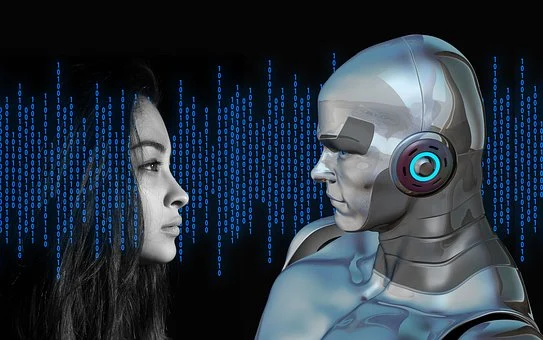
AI in “Planetoid Trilogy”: Seaswell Publishing interviews author Barrie Cameron about Artificial Intelligence (AI) in his novel, “Planetoid Trilogy”.
[ST Ref: PT-AI-Theme_interview_261008: AI in “Planetoid Trilogy”]
Seaswell Publishing (SP) interviews Barrie Cameron (BC) about AI themes in his novel, ‘Planetoid Trilogy’.
AI in “Planetoid Trilogy”
SP: AI is very topical this year, Barrie. But AI is not new, is it?
BC: Yes, it is very much on peoples minds, Ian, and you are quite correct, it is not new.
SP: In fact AI, in various forms, figures quite prominently in your recent novel, Planetoid Trilogy, does it not?
BC: Yes, that’s right. Though I would hasten to add that while it is important to the story, it is not the main theme. My novel is after all a science fiction story set in 2050 onwards. And also many science fiction novels include aspects of AI.
SP: Yes, of course, but your AI is part of the threat to Earth, is it not?
BC: Maybe, maybe not.
SP: You are being coy about this? (frowns).
BC: Maybe, maybe not (smiles enigmatically). You promised me there would be no spoilers.
SP: Yes, but we have to say something about it or there will be no interview, Barrie.
BC: OK, Ian, that’s fair. Let me think about your question for a moment.
SP: I will stop the recording until you are ready (smiles pleasantly).
AI Themes in “Planetoid Trilogy”
BC: OK, yes there are AI themes in my novel and some of them are benevolent and others are potentially not. However, my themes do not concern the exponential rise in the power of AI such as is topical at present.
SP: Your AI is already beyond that?
BC: Inevitably. Earth is in 2050 and the Planetoid is rushing at us from interstellar space. Who knows what it is carrying.
SP: Well, you do, presumably.
BC: Well, in so far as I am the author, yes. But the Planetoid is not the only potential source of AI. We meet some relatively early in Book One, “Star Island”.
SP: Would you say that your various forms of AI and their behaviour in your book are relevant to our real world AI issues in 2026?
BC: Hmm, perhaps. As I said earlier. artificial intelligence in “Planetoid Trilogy” does not represent the main theme, but AI is certainly associated with various issues faced by the characters in the story.
AI and the Fermi Paradox
SP: The aliens in your story are very advanced compared with humanity. This is a main theme, is it not?
BC: Well, the thing that inspired me to write this novel was the Fermi Paradox. How does humanity survive the exponential rise of technology when human society and evolution generally is hardly evolving at all, relatively speaking. How would an alien civilization avoid destroying itself, and what will be humanity’s fate?
SP: Yes, your novel is quite complex and contains many themes, some closely related. You also have a veritable opera full of characters to carry and interact with these themes on their way to the ultimate climax of your story.
BC: I wouldn’t classify my novel as a space opera but I see how you might feel that. I do have many characters, but it is a three volume novel.
SP: Do you think that readers might gain some insights from you novel that are relevant to the present AI issues on Earth today?
Optimism and Problem Solving
BC: My novel has been described by one reviewer as optimistic. While dystopian novels can shine lights on issues and certainly have a valuable place in literature, and particularly in science fiction, I am intrinsically a positive person, and my novel reflects that.
Perhaps this positivity comes from my engineering background. If you are planning, designing, and building things to help society, a positive attitude is not only essential it is, I would say, inevitable.
Consequently, I tend to take a positive view of humanity’s future. That is not to say that I do not recognize that there are serious problems to be solved. Of course there are. But that is what engineers do, solve problems. I would say that the most serious problems facing humanity and the environment today are all man made. Not least of all are the violence and wars inflicted on innocent people by power hungry idiots.
War and Peace
If the war mongers bothered to study history they would realize that war is not only destructive, it is extremely costly and generally does not solve anything over the long run. For example, the important advances in Europe over recent centuries were all achieved despite wars not because of them. Certainly it may be said that some advances were triggered as a reaction to war, including some revolutions, both political and technical.
SP: This futility of war is not a theme in your novel, is it?
BC: No, not specifically. The focus in “Planetoid Trilogy” is on solving a specific planetary collision threat, but then other issues arise, some of which involve warfare.
SP: You are being careful to avoid spoilers.
BC: I hope I am being successful in avoiding them.
SP: Do you wish to say anything more about AI?
AI as an Existential Threat to Humanity
BC: Hmm, only that AI which is superior in both intelligence and agency to humanity is a very real existential threat to us. One of the most effective means of limiting that threat is to disconnect the control and operation of our infrastructure from the Internet.
Industrial and infrastructure software used to be designed to not require constant updating. The software was well written, tested, and commissioned to be fit for use for the life of the component or system, without need for updating. This effectively isolates such equipment from being hacked. We have become slack and sloppy in writing software that constantly needs to be updated. Updating is not necessary if the software is properly written in the first place.
SP: I suspect that software engineers may disagree with you on this.
BC: They are being precious; and lazy; and a danger to present and future generations. Also, there are commercial reasons for requiring software products to be regularly updated.
SP: Strong words!
BC: Both strong words and strong actions are called for when it comes to regulating AI in order to ensure that humanity maintains control of our essential services and infrastructures.
SP: Even so…
Modern Software is Overly complex, Inefficient, and Vulnerable
BC: When you look at a lot of software it is very inefficient in terms of code. This is done in order to enable the rapid development of the software packages. Using software to write software tends to generate extra superfluous code. If the projects that require software to operate machinery and infrastructure were heavily modulised (as they used to be prior to the 1990s) and each module’s software kept simple (as they were in the 1990s and 2000s), reliable systems with distributed intelligence could be developed without need for software updating during the life of the equipment. This would avoid the need to connect these software systems and their independent modules to the Internet, apart perhaps from one-way data monitoring streams. Although one would need to be careful about data links too.
Another driver of inefficient and at-risk code are the modern computer operating systems that require to be routinely and frequently upgraded to protect the computer and its software from threats coming from the internet. Remove the internet connection and simplify the operating system and the need for operating system downloads and upgrades may be eliminated.
SP: That would involve a major change in industrial and commercial software development philosophy.
BC: Industrial software already has examples of what I am describing. Its not rocket science, and its not new.
Also, consider animals. When was the last time you observed the software in your brain being updated online by the town hall? Have you noticed that the nerves in your arm cannot be reprogrammed by your conscious mind? Animal nervous systems are self contained. Your brain maintains itself for your life time without need for downloads and upgrades.
SP: Efficient communications is important in organizations and projects, surely.
Communications
BC: Yes, of course. And efficient and effective cooperation is also important.
But humans can work cooperatively very effectively without being wired up to some nightmarish ‘matrix’-like download system.
The internet/smart phone/cloud system is effectively a virtual wireless ‘matrix’. The addiction to internet and smart phone use is already a major threat to our children’s mental development, individual adult mental health, and on-the-job productivity.
‘Influencers’, both known and anonymous, that push misinformation, disinformation, political and other agendas, plus negative thoughts, are major risks to human mental health, social cohesion, political stability, and modern civilization’s health and progress. Then there are vested commercial and political interests.
SP: All this because our computers need software upgrading regularly?
BC: Well, I have digressed somewhat from your original question, but many of these things are connected. Authoritarian leaders may attempt to brain wash their people but you may have noticed that this generally does not lead to good outcomes for anyone, including the dictators. Future AI and others would find it more difficult to control human society if the software used within government, services, and industry was isolated from the AI engines, data centers, and their manipulators, who ever they may turn out to be.
Software upgrades pose potential risks
Computer software products that need continual upgrades from the internet present serious risks to the security of infrastructure, industry, and commercial systems that use the computerized products for supervision and control. Computer firewalls are not sufficient safeguards as they may be penetrated by apparently innocent software carrying hidden viruses or bots, as demonstrated by incidents that occur throughout the world from time to time. Super AI and quantum computing will only aggravate this risk.
SP: Are we getting political now.
BC: Realistically, any matters involving the health, safety, and wealth of individuals and organizations tend to be political. Then there is geopolitics where national politics becomes entwined with international and geographically influences.
Geopolitics
SP: Geopolitics is one of the themes of your novel.
BC: Yes, it certainly is.
SP: Your story’s fictional characterizations of Earth’s power blocks are undoubtedly interesting and thought provoking, not to mention those of the aliens.
BC: The novel’s geopolitics expands into a wider, cosmic, theatre. This is perhaps a good place to wind up our discussion, do you think, Ian?
SP: Yes, I agree, Barrie, before there any more inadvertent spoilers.
{End of interview]
[Post last updated: 15/10/2026]