This Blog post #7 is entitled: Biodiversity – Ecosystems. It follows our last post #6: “Biodiversity – Functions” of this Biodiversity series.
This present post is inspired by chapter 5, “Ecosystems”, of Antonelli’s book, “The Hidden Universe: Adventures in Biodiversity”.
Biodiversity – Ecosystems
In Chapter 5 of his book, Antonelli begins by referencing Humboldt‘s visit to Ecuador during the German naturalist’s adventures in the jungles of South America.
Humboldt documented the changes in species of plants and animals with altitude. He saw how these variations in ecosystems were affected by changing topography and climate, Through his other travels around the world and correspondences with other scientists, Humboldt described how similar diversity of ecosystems, each with its own set of species and characteristics, was a world wide phenomena.
Diversity of Ecosystems
Antonelli explains, with examples, that the diversity of ecosystems on Earth is key to explaining why there are so many species and why they exhibit such large variations in life form, behaviour and functions.
He states that focusing on the conservation of ecosystems is more effective than focusing on single species. This is, he points out, because species can rarely be protected in isolation.
Scheme of Ecosystems
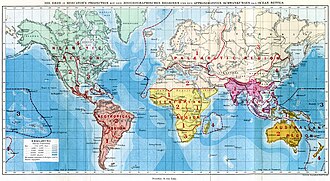
Antonelli informs us that the World Wide Fund for Nature has adopted a common scheme which is aggregated into eight realms of ecosystems. Most of these realms were identified in the 1800s by various naturalists, including Alfred Russel Wallace. The realms contain 14 biomes (e.g. boreal forests, mangroves, etc.), and these are further subdivided into 867 ecoregions (e.g. Temperate broadleaf, mixed forests, etc.).
Climate and Ecosystems
The connection between climate and type of ecosystem, Antonelli notes, was observed by Humboldt during his world wide travels and since confirmed by the modern study of climate and ecosystems aided by the global network of weather stations.
Annual variation, or seasonality, is a key aspect that predicts the regional development of ecosystems. Antonelli quotes the example of the Cerrado savannah of South America. Because rain is restricted to only a few months of the year, the Cerrado savannah is prevented from being an evergreen forest despite its high annual rainfall.
Human Disturbance
The activities of humans, such as removing large animals and introducing fire and cattle, can disturb the natural balance of the ecosystems. Antonelli discusses the issues of fire, both human induced and from natural causes. Fire can play an important role in the life of forests and ecosystems generally. Balance in the environment is a delicate thing.
Transitions between Ecosystems
Natural geographical barriers, such as mountains, can result in abrupt transitions between ecosystems. Antonelli gives examples of this common phenomenon. The geographic feature can cause sudden changes in local climatic that produce these transitions between neighbouring ecosystems.
Ecosystems are Transient
Like species, ecosystems are transient. Antonelli discusses diverse examples of transient ecosystems. His examples include recent events and changes that have occurred far in the past and over long periods of time. Climate change is a major driver of these changes.
Tipping Points
He recommends that we do not take today’s ecosystems for granted. He discusses ‘tipping points’ and ‘points of no return’. He tells us that Amazonia, the world’s largest rainforest, “could turn irreversibly into a savannah from the point at which 20-25 per cent of its total forest is lost”. It has already lost 18 percent of its pre-human forest area! Antonelli quotes examples of dramatic historical ecosystem changes.
Summary – the Biodiversity Star, a fine-tuned telescope…
Antonelli completes his chapter on ecosystems by reminding us of his five pointed star of Biodiversity. He likens the five points of the biodiversity star: species, genes, evolution, functions and ecosystems, with five aligned and complementary lenses of the same fine-tuned telescope. A biodiversity telescope which “allows us to explore, understand, and really see our living planet”.
This summary leads us to consider the next section of his book: Part Two – The Values of Biodiversity in our next post in this series.
The next Blog post, #8 of this series, will be entitled: “Biodiversity – Values” and will be inspired by Part Two, “The Values of Biodiversity”, of Antonelli’s book, “The Hidden Universe: Adventures in Biodiversity”.
(Post Dated: 25/06/2026)