Seaswell Publishing is the independent publisher for Barrie Cameron’s self-published books, using the ‘SEASWELL’ imprint. Cameron’s books include E-books and paperbacks.
On this page, we introduce our authors with a bio summary. You will be able to access more information on these authors from their author websites.
Barrie Cameron
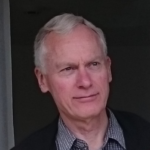
Barrie Cameron lives in New Zealand and is an Electrical Engineer. Since an early age, he has had an interest in writing. However it is only recently that he has found time to become an author of fiction.
Speculative Fiction
In 2020, Cameron began writing speculative fiction. He has published a novel, ‘Planetoid Trilogy’, and is currently writing another. He has also recently begun to write short stories.
Author’s Website
You will find more information about Cameron and his writing on his website at https://www.barriecameronauthor.com/.
Novels
Cameron’s first novel published under the ‘Seaswell’ imprint, ‘Planetoid Trilogy’, is an adventure story set in the near future. While it may be considered a science fiction novel, it explores various themes including that of geopolitics.
Writing Influences
He was encouraged to take up writing novels by recent developments in science, especially in the areas of astrophysics and quantum mechanics. But he is also influenced by biology, history, archaeology, and human culture generally.
For his first novel, ‘Planetoid Trilogy’, he was particularly fascinated by the question as to whether a technically advanced civilization could overcome the implied dangers of the Fermi paradox and escape the proposed extinction filter.
Planetoid Trilogy
Cameron has set his Planetoid Trilogy novel in the near future. He has chosen a hybrid genre of soft and hard science fiction.
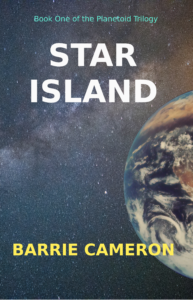
You can view a review of ‘Star Island‘, the first book of the ‘Planetoid Trilogy’, in Goodreads, here.
Definitions
Hard Science Fiction
‘Hard science fiction‘ refers to the use in the novel of realistic human science and technology of the twenty-first century.
Soft Science Fiction
‘Soft science fiction‘ refers to the exploration of the soft sciences (see below) but it also refers to speculative technology. In addition to the application of some “soft” sciences, Cameron uses some artistic license in his introduction of speculative technologies in order to bring the alien dimension to his tale. The alien presence is of course essential to the main theme.
Wikipedia’s Definition of Soft Sci-Fi
“Soft science fiction, or soft SF, soft sci-fi, is a category of science fiction with two different definitions, in contrast to hard science fiction.[1] It explores the “soft” sciences (e.g. psychology, political science, sociology), as opposed to the “hard” sciences (e.g. physics, astronomy, biology).[1] It can also refer to science fiction which prioritizes human emotions over scientific accuracy or plausibility.[1]“
Speculative Geopolitics
The ‘Planetoid Trilogy’ also features speculative geopolitics on Earth and in the solar system of the future. The mid-twenty-first century world is in stress from global warming, and now there is a new danger arriving from out of interstellar space!
The Heroes and their Mission
The heroes of the story then undertake a dangerous mission. Throughout the story, their adventure is clouded by mystery. Yet regardless of the hidden perils that they risk on their journey, they must overcome the greater challenge of not only an existential threat to human civilization but also to the Earth’s biosphere!
Technically Advanced Civilizations
Are there already technically advanced civilizations in our galaxy and, if there are, will humanity survive long enough to join their ranks?
The Great Filter
The Fermi Paradox asks whether there are technically evolved extraterrestrial alien civilizations hidden amongst the stars of our Milky Way galaxy that may have managed to avoid extinction by a so called ‘great filter‘. This hypothesis suggests an inverse correlation between the probability that other life could evolve to the present stage in which humanity is, and the chances of humanity to survive in the future.
Galactic Statistics
There is also the very high likely hood that if there is an existing technologically advanced alien civilization in our galaxy, it is probably at least several hundred thousand years in advance of ours.
Does Humanity have what it takes?
The further question then arises, does humanity itself have the capability to avoid such an extinction in the near future from some such ‘great filter’ as proposed by the ‘paradox’.
The PLANETOID Trilogy has as one of its major themes this question of whether humans have the potential to avoid the fate that may have limited the existence of space-faring extraterrestrial technological alien civilizations.
And then there are the views of modern Physicists…
Given the limitations to space travel posed by very real relativistic considerations, such as the speed of light and conservation of momentum and energy, Physicists are generally very skeptical of the concept of interstellar travel, regardless of how technologically advanced an alien civilization might be.
This raises the speculative question: is the state of our existing knowledge of science sufficient for us to make this assessment?
Social Media
You can use the links below to go to Barrie Cameron Author pages at: Facebook, and Amazon:
Science Topics
On our Science Topics page, you can see our brief discussions of the Fermi paradox, and two related topics, exoplanets, and likely alien behaviour, These are just three of the science topics featured.
Planetoid Trilogy
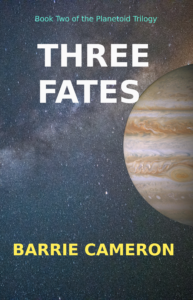
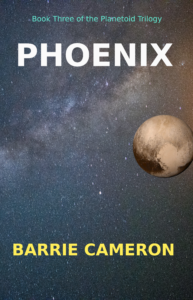
The three books in the Planetoid Trilogy are: Star Island, Three Fates, and Phoenix.
(For more bio information, click here).
(Page updated: 20/05/2026).